Why AI is Becoming Essential for Modern Businesses
Discover how AI is transforming small and medium businesses in 2026. Learn practical automation strategies and growth insights with Expandorix.
How AI is Transforming Small and Medium Businesses in 2026
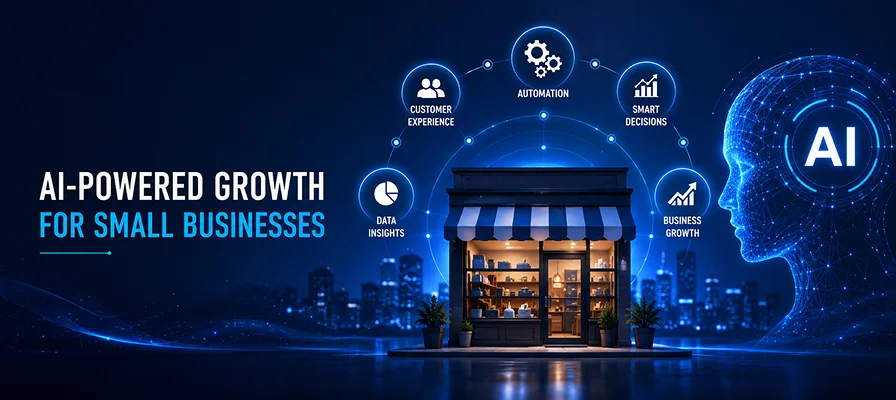
AI has moved from a distant concept to a practical business tool that small and medium enterprises now rely on in daily operations. Artificial intelligence is no longer limited to large corporations with huge budgets. It has become accessible and essential for growth. Businesses are employing AI to optimize operations and decision making across various functions including customer service, inventory management and more. It is not only a technical change but it is a strategic change as companies rethink and reimagine how they work in a competitive market. AI for small businesses is helping them to cut costs and better serve their customers while also being able to adapt to evolving demands rapidly.
Expandorix.com supports businesses in adopting AI with practical solutions that fit real operational needs. It focuses on helping SMEs integrate smart tools without unnecessary complexity. It also allows them to improve efficiency while maintaining control over their processes and long term business goals.
Why AI is Becoming Essential for Modern Businesses
Artificial intelligence for business is becoming essential because it addresses the core challenges that businesses face today.
Markets move quickly while customer expectations continue to rise and competition is no longer limited by geography. Manual systems and rigid rules can be time consuming especially when it comes to decision making.
AI changes this by analyzing data in real time and offering insights that would otherwise take hours or days to produce. With predictions of demand, businesses can now understand customer behavior and make better decisions.
The other factor why it is gaining importance is cost efficiency. AI for small business can help to minimize repetitive tasks as well as offer time for employees to concentrate on tasks that demand judgment and creativity.
This AI digital transformation will boost productivity without adding to the workforce. AI can decrease mistakes particularly in areas like accounting and customer communications.
AI also supports better customer experiences. Chat systems as well as recommendation engines and automated responses allow businesses to remain responsive at all hours. Customers expect quick answers and personalized service and AI makes both possible without placing extra pressure on staff.
Key Areas Where AI is Transforming SMEs
AI for SMEs is transforming several key areas within small and medium businesses which makes operations more efficient and reliable.
- One of the most visible changes is in customer service. AI driven chat tools can handle common queries as well as process requests and guide customers through basic issues. This allows businesses to offer consistent support without expanding their teams.
- Marketing is another area where AI has made a strong impact. Businesses can now analyze customer data to understand preferences along with buying patterns and engagement levels.
- This leads to more targeted campaigns that reach the right audience at the right time. Instead of broad messaging companies can focus on relevance which improves conversion rates.
- Operations and inventory management have also improved. AI systems can track stock levels as well as predict demand and suggest restocking schedules. This reduces both shortages and excess inventory which helps control costs and improve cash flow.
- Financial management is becoming more accurate with AI tools for SMEs that track expenses, identify irregularities and generate reports. These systems provide clarity and reduce the risk of oversight.
- Human resource functions are also changing. AI assists in screening applications, managing schedules and tracking performance. This simplifies administrative work and allows managers to focus on team development.
- These AI business automations show that AI is not limited to one department. It is shaping the entire structure of how SMEs operate and grow.
AI-Powered Automation vs Traditional Systems
The capability and flexibility of AI-powered automation differ from traditional systems. Traditional systems are based on rules that are programmed in advance. They perform tasks exactly as programmed without adapting to new conditions unless manually updated. This method is effective for stable processes but ineffective when there are changes in the situation.
AI automation on the other hand learns from data. It can identify patterns, adjust responses and improve over time without constant human intervention. In a traditional system, for instance, when a customer raises a question, certain employees handle it in a specific way, while in an AI-driven system, the tone, intent and context of a customer's message can be analysed before an appropriate response is sent.
The other difference is scalability. Traditional systems typically need extra resources and system setup to accommodate growth. AI systems can scale better as they can handle massive amounts of data and interactions without necessarily increasing manual workload.
Cost is also a factor. While traditional systems may seem less expensive at first, they often require ongoing maintenance and updates. AI systems once implemented properly can reduce long term costs by improving efficiency and minimizing errors.
AI business automation provides a more responsive and flexible solution in real world scenarios. Businesses can respond quickly to changes as well as make informed decisions and operate with greater accuracy than with traditional systems.
Real World Benefits of AI for Small Businesses
The benefits of AI for small businesses are clear when observed in everyday operations. Time saving is one of the immediate benefits. Once a time-consuming task can now be done in minutes. This enables business owners and employees to concentrate on planning and growth, instead of standard business operations.

Cost reduction is another key benefit. AI helps optimize resource use, whether it is managing inventory or scheduling tasks. Businesses can operate more efficiently without increasing expenses.
Improved decision making is also significant. AI systems provide insights based on real data which reduces guesswork. Business owners can rely on accurate information when planning marketing campaigns or managing supply chains.
Customer satisfaction is improved as well. Responsive return, tailored suggestions and uniformity of service provide better service. This helps to improve the relationship with customers and repeat sales.
AI in small business operations is helping with the growth as well. Increased demand means that businesses can manage to deal with larger workloads without having to make any significant changes to their structures. This flexibility enables SMEs to grow with assurance.
Common Myths About AI in Business
Though the use of AI has increased, there are still some misunderstandings regarding it. A common misconception is that AI is just for large companies. The truth is that there are a lot of
Another myth is that AI replaces human workers entirely. While AI does automate certain tasks it mainly supports employees by reducing repetitive work. People remain essential for decision making along with creativity and relationship management.
Some business owners believe AI is too complex to implement. But there are many AI tools for SMEs that are user friendly and do not require any technical knowledge. By following the right steps, businesses can make use of AI without causing significant disruption.
Cost is also misunderstood. While there is an initial investment, the long term savings often outweigh the expense. AI reduces errors as well as improves efficiency and lowers operational costs over time.
There is also concern about losing control. AI systems are designed to assist and not replace human oversight. Businesses can monitor performance and adjust settings as needed.
By understanding these business AI solutions companies can reduce the hesitation of AI and use this groundbreaking technology in a more informed way.
How Businesses Can Start Using AI Today
Starting with AI does not require a complete overhaul of existing systems. Businesses can start simply by taking concrete action to meet their immediate needs. The first step is to identify the areas of overuse in time and resources. Tasks such as customer support as well as data entry and inventory tracking are often good starting points.
It is crucial to select the right AI tools for SMEs. Some solutions can help a business of a certain scale and in a certain industry. In fact, many platforms will have built-in features that can be set up without a lot of hassle.
Staff training is another important consideration. Staff should be aware of the proper use of AI and its utility in their tasks. This will facilitate the smoother adoption and better results.
It is also useful to monitor performance. Businesses should track how AI tools impact efficiency along with cost and customer satisfaction. This helps in refining the approach and making informed adjustments.
Partnering with seasoned service providers can make the job easier. They are able to advise businesses on the most appropriate solutions for them.
Conclusion
AI is no longer an optional upgrade for small and medium businesses. It has become a practical necessity for those who want to remain competitive and efficient in a changing market. Businesses have a clear advantage in having the ability to automate tasks as well as analyze data and enhance customer experiences. But smart adoption of AI requires careful consideration and a clear understanding of business needs.
Expandorix.com plays an important role in implementing AI in small business operations in a structured and manageable way. With the right approach SMEs can use AI not just to keep up but to grow steadily.